

Gastrointestinal cancers, including malignancies of the oesophagus, stomach, colorectum, pancreas, liver, and biliary tract, represent a leading cause of cancer morbidity and mortality worldwide [1]. According to the Global Burden of Disease Study (GBD), there were around 5.26 million incident cases and 3.70 million deaths from gastrointestinal cancers in 2021 [1]. Gastrointestinal cancers most commonly affect older populations; however, there is an increasing trend in early-onset gastrointestinal cancers (EOGIC), defined as diagnoses occurring before the age of 50 [2–6]. In 2021, approximately 499 800 new cases and 285 900 deaths were attributed to EOGIC, accounting for 9.5% of gastrointestinal cancer incident cases and 7.7% of deaths globally [7]. Although early-onset cases still comprised a relatively smaller proportion of the total, their increasing incidence, worse survival outcomes, substantial years of life lost, and socioeconomic consequences have made them an urgent public health concern [2,8].
Early-onset gastrointestinal cancer is associated with modifiable behavioural risk factors including poor-quality diet, sedentary lifestyle, cigarette smoking, and high alcohol consumption [9,10]. Since the mid-20th century, global trends towards more-westernised diets and lifestyles have been significant drivers in the shifting age profile of gastrointestinal cancer [2,11]. In 2019, 34.4% of disability-adjusted life years of early-onset colorectal cancer (EOCRC) globally were attributable to dietary risks [12]. Worldwide consumption of processed meat and sodium in 2017 was 90%, and 86% greater than the optimal levels [13]. A large prospective cohort with more than 20 years of follow-up showed that sedentary television viewing time was statistically significantly associated with increased risk of EOCRC (relative risk = 1.69; 95% confidence interval (CI) = 1.07–2.67) [14]. The estimated total sitting time increased in the USA from 2007–2016 (7.0–8.2 hours/d among adolescents, and 5.5–6.4 hours/d among adults) [15]. Moreover, the number of smokers globally has increased steadily each year since 1990, when there were 0.99 billion smokers in 2019 [16]. Additionally, global adult alcohol per capita consumption increased from 5.9 L to 6.5 L between 1990–2017, and is forecasted to reach 7.6 L by 2030 [17]. Particularly, people of younger age (20–39 years) are disproportionately affected by alcohol consumption [18]. Given these trends, addressing these behavioural determinants remains critical but complicated.
Previous research has advanced our understanding of EOGIC incidence and associated risk factors, yet noticeable gaps remain. Some studies only focused on one or two cancer types (most often colorectal) [11,19–21]. Other studies only described the EOGIC deaths and disability-adjusted life years due to existing risk factors, or emphasised metabolic risk factors while overlooking the role of modifiable behavioural exposures [7,22]. However, a comprehensive assessment that distinguishes contemporary global incidence patterns, registry-based temporal trends in settings with high-quality data, and country-level ecological associations with behavioural risk factors across major EOGIC subtypes remains limited. This study addressed this gap by leveraging GLOBOCAN 2022 database to deliver a systematic and updated description of incidence for total EOGIC and its six types (EOCRC, early-onset oesophageal cancer (EOEC), early-onset gallbladder cancer (EOGC), early-onset liver and intrahepatic bile ducts cancer (EOLC), early-onset pancreatic cancer (EOPC), and early-onset stomach cancer (EOSC)). It further quantified the association of key behavioural risk factors using Shapley additive explanations (SHAP) and regression modelling to identify high-impact exposures. This integrated approach can enhance our epidemiological understanding and provide scientific evidence to inform global gastrointestinal cancer prevention strategies tailored to younger populations.
Adherence to JoGH’s Guidelines for Reporting Analyses of Big Data Repositories Open to the Public (GRABDROP)
This study adhered to JoGH’s guidelines for Reporting Analyses of Big Data Repositories Open to Public [23]. Details of adherence are provided in Table S1 in the Online Supplementary Document. This study additionally followed the Guidelines for Accurate and Transparent Health Estimates Reporting statement where applicable (Table S2 in the Online Supplementary Document).
METHODS
Data source
Early-onset gastrointestinal cancer is typically defined as gastrointestinal cancer diagnosed in individuals younger than 50 years [9]. In this study, we operationalised EOGIC as gastrointestinal cancers occurring at ages 15–49 because the publicly available age-stratified incidence and exposure data used for cross-database harmonisation were available for this age range, and gastrointestinal cancers are rare in children and may have distinct biological and clinical characteristics [24,25]. Our definition captured adolescent and adult EOGIC rather than all cancers diagnosed before age 50.
For current incidence description, we collected the data on incident cases and age-standardised incidence rates (ASIRs) of overall EOGIC and its six specific types from the GLOBOCAN 2022 database published by the International Agency for Research on Cancer (IARC) [26]. The GLOBOCAN database comprises estimates of incidence data of 36 cancer diseases across 185 countries or regions worldwide, including age-stratified and sex-stratified data, up to the year 2022 [27]. The sites of six major gastrointestinal cancers were identified using the International Classification of Disease (ICD, 10th revision) codes: oesophagus (C15), stomach (C16), colorectum (C18–C21), liver and intrahepatic bile ducts (C22), gallbladder (C23), and pancreas (C25).
For analysis of trends over time, we obtained annual incidence data from the Cancer Incidence in Five Continents (CI5) plus published by the IARC. The CI5 plus database contains updated annual incidence rates for 135 selected populations from 111 cancer registries, which can be used for time trends analyses [28]. The data used in this study comprised available ASIRs of EOGIC in 46 countries from the CI5 plus. Because CI5 plus data were derived from registry populations already evaluated within the IARC framework, the underlying data quality reflects the CI5 emphasis on comparability, completeness, and validity [29,30]. The period 2008–2017 was used for ASIR trends, except for Japan (2006–2015), Spain (2007–2016), and Costa Rica (2007–2016), where the most recent incidence data ended earlier [31].
To investigate potential factors influencing the incidence rates of EOGIC, we also extracted summary exposure values (SEVs) of behavioural risk factors among individuals aged 15–49 in 2022 from the GBD 2023 database. The SEVs represented the age-specific risk-weighted prevalence of exposure, and are reported on a 0–100 scale, where 0 equates to a scenario in which the entire population is exposed at the theoretical minimum risk exposure levels, and 100 indicates that the entire population is exposed at the maximum risk exposure level [32,33]. Country-level incidence estimates from GLOBOCAN 2022 were matched to GBD 2023 SEVs using standardised country names. The final analysis included 179 countries with available data for both incidence and SEV variables.
The aforementioned three data sources were used for distinct but complementary analytic purposes (Table S3 in the Online Supplementary Document). The present study did not infer global temporal trends directly from GLOBOCAN 2022, nor did it assume that CI5 plus trend findings are globally representative.
Selection of behavioural risk factors
Behavioural risk factors were screened using a multistep procedure. First, we extracted 25 behavioural risk factors among individuals aged 15–49 years from GBD 2023. Iron deficiency was excluded because of possible reverse causation, and bullying victimisation, sexual violence against children, and intimate partner violence were excluded because they showed no preliminary association, leaving 21 candidate factors. For overall EOGIC and each type, candidate factors were then prioritised using random forests and SHAP analyses. We chose SHAP because it is a model-agnostic method that can be applied to any machine learning model and provides a ranking of variable importance [34]. In this context, machine learning can effectively address many issues from numerous risk factors and complex relationships, such as correlations and nonlinearity, which traditional statistical methods might not [34]. Behavioural risk factors previously reported for specific cancer types in GBD 2023 were additionally considered for type-specific models when appropriate. For the retained factors, a generalised linear model (GLM) using a log link with a Poisson distribution was adopted to further identify behavioural risk factors with significantly positive effects and estimate the ecological incidence rate ratios (IRR). The dependent variable was the number of incident cases for overall EOGIC or each subtype at the country level, with the logarithm of the corresponding population size included as an offset term. Overdispersion was assessed and found to be acceptable.
Statistical analysis
We presented the absolute number and rates of incidence by region, country, sex, and age-group in 2022. The estimated annual percentage changes (EAPCs) of rates were calculated to reflect the temporal trends of EOGIC incidence rates between 2008–2017. The EAPC was calculated by fitting the linear regression models as y = α + βx + ε, where y refers to ln (rate) and x represented the calendar year. The value of EAPC and corresponding 95% CIs were computed as 100 × (exp (β) − 1) [35]. If both the EAPC and its 95% CI were above or below zero, a rate was identified as indicative of an increasing or decreasing trend over time. In instances where the 95% CI encompassed zero, we deemed the change in ASIR statistically insignificant.
For the identified risk factors related to the incidence rates of EOGIC, we calculated the model-based attributable fraction estimates based on the ecological IRRs from the GLM model. These estimates were exploratory and should not be interpreted as causal attributable fractions. The model-based attributable fraction estimates of the ith risk factor for the jth disease were calculated as follows [34,36]:
model − based attributable fraction estimatesij =

where x denotes the SEV of the risk factor, and min and max denote the minimum and maximum exposure levels of each risk factor; IRRij(x) is the ecological IRR value obtained in GLM for the association of the ith risk factor with the occurrence of the jth disease at exposure rate x; Pi(x) represents the SEV distribution of the ith risk factor globally; and Pi*(x) indicates the theoretical distribution of the minimum-risk exposure level for the ith risk factor, estimated from exposure level distributions below the median global exposure rate across countries and territories [34].
To assess the potential impact of infectious and metabolic confounding, we conducted a sensitivity analysis by further adjusting the ecological models for country-level chronic hepatitis B prevalence, high body-mass index (BMI), and high fasting plasma glucose using available data from the GBD 2023. Considering lag effects of exposures, we conducted an additional sensitivity analysis using five-year lagged behavioural SEVs (2017) while retaining 2022 incidence as the outcome. The ecological models were otherwise specified identically to the primary analysis, and the corresponding ecological IRRs and model-based attributable fraction estimates were recalculated. All data analyses were performed using R V.4.3.2 (R Foundation for Statistical Computing, Vienna, Austria). P-value less than 0.05 was considered statistically significant.
RESULTS
Global incidence of early-onset gastrointestinal cancers
Globally, an estimated 465 584 (277 329 males, and 188 255 females) new cases of EOGIC occurred in 2022, accounting for 9.49% (9.32% males, and 9.76% females) of all-age incident cases of gastrointestinal cancers (Table 1; Figure S1 and Tables S4 and S5 in the Online Supplementary Document). The ASIR of EOGIC was 11.50 per 100 000 persons worldwide, with a higher rate in males than in females (13.60 vs. 9.40 per 100 000, respectively). Among the six types of early-onset gastrointestinal cancers, EOCRC ranked the highest in both incident cases (N = 186 840) and ASIR = 4.60 per 100 000, followed by EOLC and EOSC (Table 1; Figure S2 in the Online Supplementary Document). Early-onset colorectal cancer accounted for the largest share of EOGIC incident cases both among males (35.55%) and females (46.88%) (Figure 1). The ASIRs for most types of early-onset gastrointestinal cancers were higher in males than in females, with the exception of EOGC, for which the rate was lower in males than in females (0.18 vs. 0.49 per 100 000) (Figure S3 and Tables S4 and S5 in the Online Supplementary Document). Both incident cases and ASIRs of early-onset gastrointestinal cancers were substantially higher in the 30–49-year group than in the 15–29-year group (Figure S4 in the Online Supplementary Document).
Table 1. Incident cases and age-standardised incidence rates of early-onset gastrointestinal cancers in 2022
ASIR – age-standardised incidence rate, EOCRC – early-onset colon and rectum cancer, EOEC – early-onset oesophageal cancer, EOGC – early-onset gallbladder cancer, EOGIC – early-onset gastrointestinal cancer, EOLC – early-onset liver and intrahepatic bile ducts cancer, EOPC – early-onset pancreatic cancer, EOSC – early-onset stomach cancer, HDI – human development index
Figure 1. The proportions of incident cases of six types of early-onset gastrointestinal cancers among different regions in 2022. EOCRC – early-onset colon and rectum cancer; EOEC – early-onset oesophageal cancer; EOGC – early-onset gallbladder cancer; EOLC – early-onset liver and intrahepatic bile ducts cancer; EOPC – early-onset pancreatic cancer; EOSC – early-onset stomach cancer; HDI – human development index.

Regional and national incidence of early-onset gastrointestinal cancers
In 2022, the highest number of incident cases (n = 205 168) and ASIR = 13.20 per 100 000 of EOGIC were observed in high Human Development Index (HDI) countries. Among 21 UN regions, Eastern Asia (n = 147 677) had the greatest absolute numbers of incident cases, followed by South Central Asia (n = 90 261) and Southeastern Asia (n = 42 430) (Figure S5 in the Online Supplementary Document). The highest ASIRs of EOGIC were detected in the Australia-New Zealand (ASIR = 18.70 per 100 000), followed by Northern America (ASIR = 16.80) and Eastern Asia (ASIR = 16.00) (Figure S2 in the Online Supplementary Document). Although EOCRC contributed the most to the early-onset gastrointestinal cancer incidence in most regions, EOLC was dominant in the Western Africa, Middle Africa, Eastern Asia, Micronesia, and Melanesia (Figure 1).
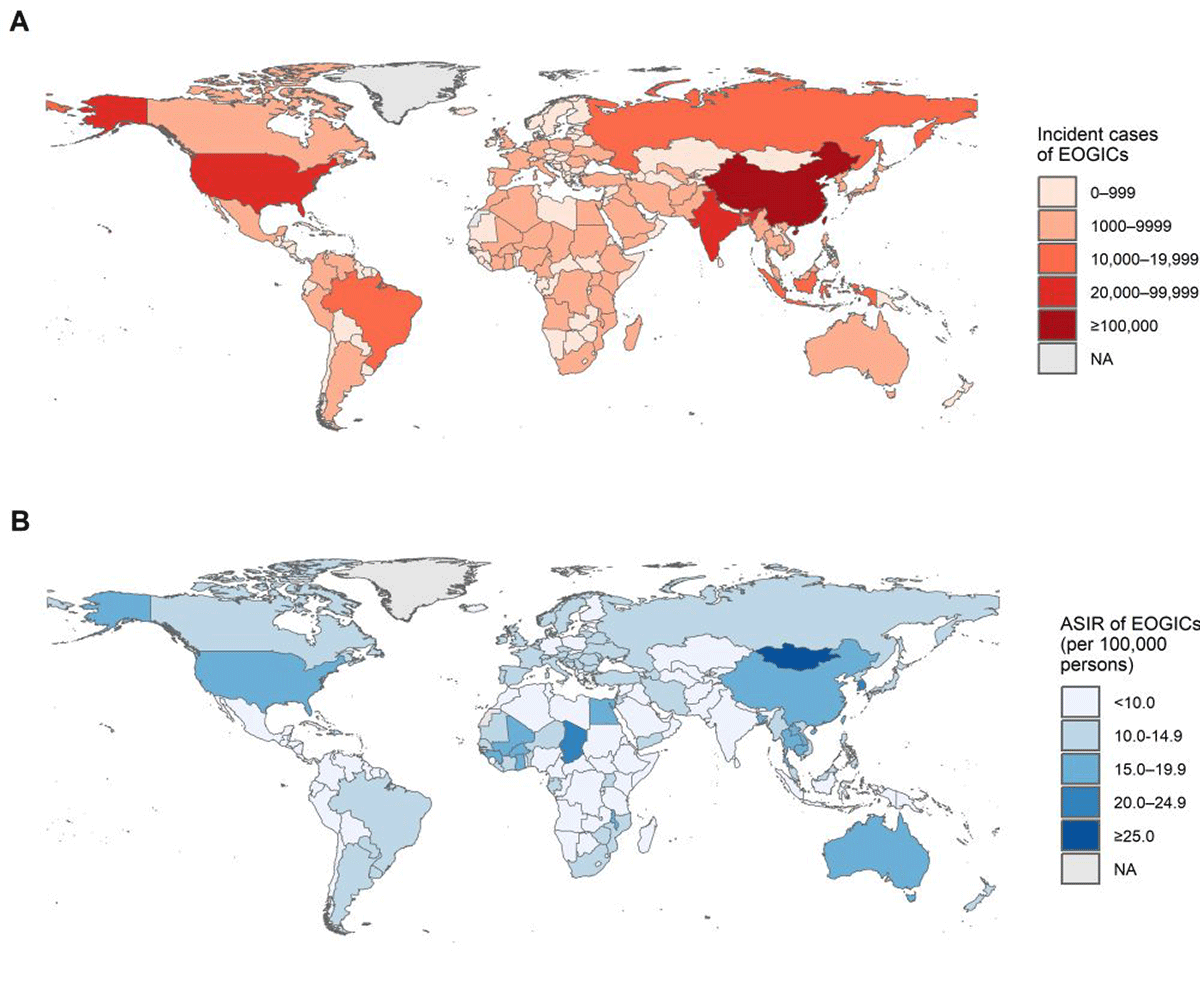
At the national level, China (n = 130 030) exhibited the largest number of incident cases of EOGIC, followed by India (n = 54 896) and USA (n = 28 769) (Figure 2, Panel A). The highest ASIRs of EOGIC were found in Mongolia (ASIR = 32.20 per 100 000), Republic of Korea (ASIR = 21.70 per 100 000), and Republic of the Gambia (ASIR = 20.70 per 100 000) (Figure 2, Panel B; Table S6 in the Online Supplementary Document). China had the largest counts of incident cases for EOCRC, EOLC, EOPC, and EOSC, while the greatest numbers of incident cases for EOEC and EOGC were in India (Figure S6 in the Online Supplementary Document). The highest ASIRs were in Australia for EOCRC, Malawi for EOEC, Bangladesh for EOGC, Mongolia for EOLC and EOSC, and Burkina Faso for EOPC (Figure S7 in the Online Supplementary Document).
Figure 2. The incident cases and ASIRs for EOGIC in 2022 by country [37]. Panel A. Incident cases. Panel B. ASIRs. ASIR – age-standardised incidence rate, EOGIC – early-onset gastrointestinal cancer.
Ten-year trends in ASIRs
Among the 46 countries with at least 10 years of EOGIC incidence data meeting CI5 plus quality criteria, the ASIRs significantly increased in 36.96% (n/N = 17/46) of countries between 2008–2017 (Figure S8, Panel A in the Online Supplementary Document). The greatest EAPCs were observed in Puerto Rico (EAPC = 4.44; 95% CI = 2.75–6.15) and Iceland (EAPC = 4.31, 95% CI = 0.25–8.53). By sex, ASIRs of EOGIC significantly increased in 18 countries among female and in nine countries among males (Figure S8, Panel B in the Online Supplementary Document). The ASIRs of EOCRC and EOPC increased in 25 and 10 countries, respectively, whereas those of EOSC and EOLC decreased in 15 and 10 countries. The ASIRs of EOEC and EOGC remained stable in 35 and 34 countries (Figure S9 in the Online Supplementary Document). Across the countries included in CI5 plus analyses, there were limited and inconsistent sex disparities in the 10-year ASIR trends for the six types of early-onset gastrointestinal cancers (Figure S10 in the Online Supplementary Document).
Behavioural risk factors related to early-onset gastrointestinal cancers
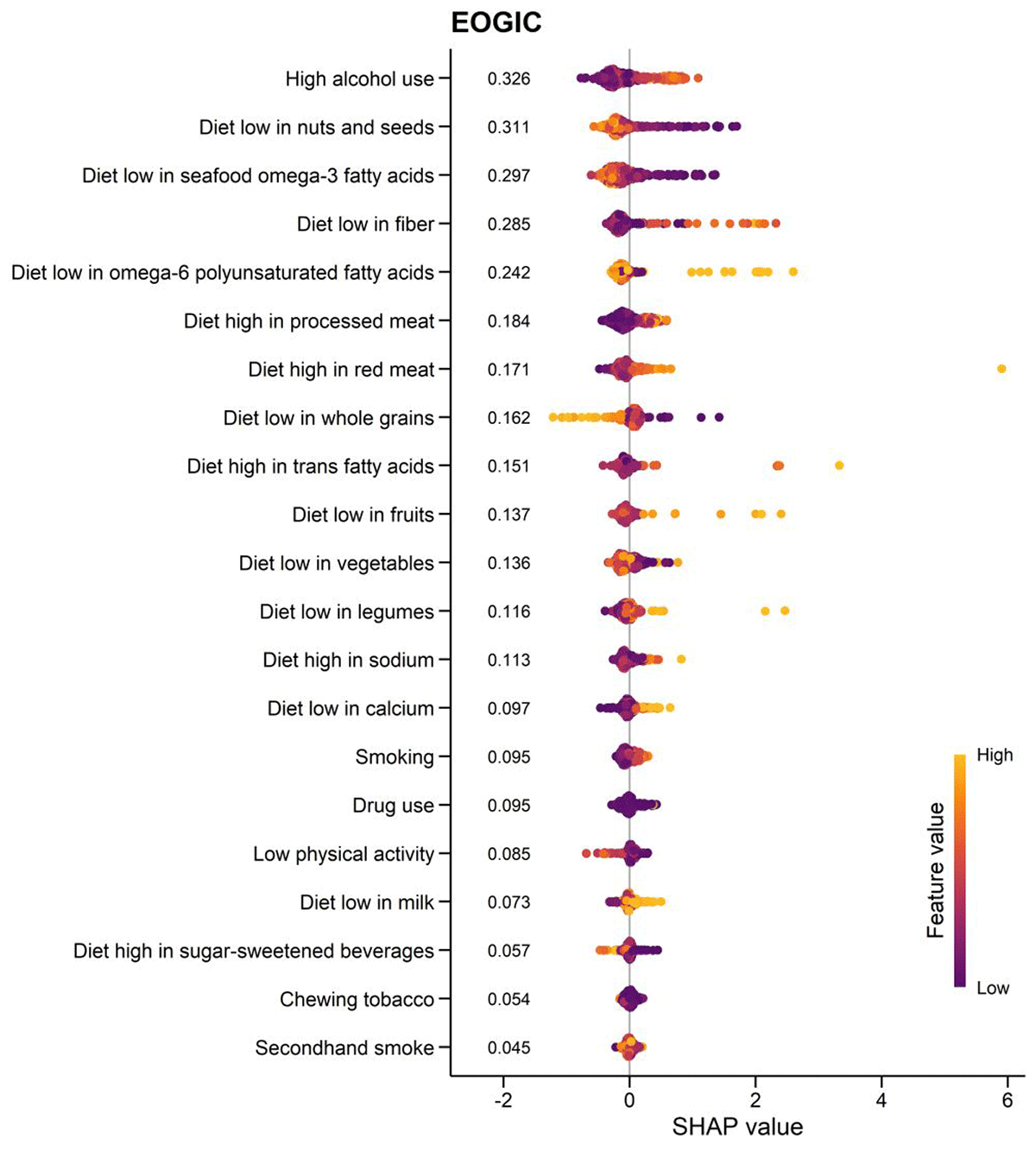
Behavioural risk factors entered into the ecological models were selected through a predefined multistep workflow combining GBD-based candidate identification, exclusion of factors with possible reverse causation or no preliminary association, random forest and SHAP-based prioritisation (Figure 3; Figure S11 in the Online Supplementary Document), and final regression screening. Ultimately, seven behavioural risk factors were retained for overall EOGIC, and six, five, three, five, two, and five factors were retained for EOCRC, EOEC, EOGC, EOLC, EOPC, and EOSC, respectively (Figures S12–18 in the Online Supplementary Document).
Figure 3. SHAP summary plot illustrating the impacts of behavioural risk factors on total gastrointestinal cancer. EOGIC – early-onset gastrointestinal cancer, SHAP – Shapley additive explanations.
After adjustment for the other variables, several behavioural risk factors showed positive associations with EOGIC incidence. Higher SEVs for diet high in red meat (ecological IRR = 1.24; 95% CI = 1.23–1.25) and smoking (ecological IRR = 1.19; 95% CI = 1.18–1.20) showed the strongest positive associations with overall EOGIC incidence (Figure S19 in the Online Supplementary Document). Higher alcohol-use SEVs were also positively associated with the incidence of EOCRC, EOEC, EOLC, EOPC, and EOSC (Figure S20 in the Online Supplementary Document). In the model-based attributable fraction estimates derived from the ecological analyses, diet high in red meat and smoking showed the largest attributable fraction estimates for overall EOGIC incidence, at 12.78% and 8.17%, respectively. Smoking also showed relatively large estimates for EOCRC (11.29%) and EOPC (23.97%). High alcohol use corresponded to attributable estimates of 3.14%, 1.57%, 7.39%, 3.75%, and 6.88% for EOCRC, EOEC, EOLC, EOPC, and EOSC, respectively. In addition, diet high in sodium showed the largest attributable estimate for EOSC (15.41%) (Table S7 in the Online Supplementary Document).
In sensitivity analyses with additional adjustment for chronic hepatitis B prevalence, high BMI, and high fasting plasma glucose, the main ecological associations remained broadly consistent in direction and magnitude (Table S8 in the Online Supplementary Document). In sensitivity analyses using five-year lagged exposures, the main ecological associations were largely preserved (Table S9 in the Online Supplementary Document).
DISCUSSION
Our study serves as the most up-to-date report on the EOGIC incidence at the global, regional, and national levels. It is also the first to investigate associated behavioural risk factors for EOGIC using both machine learning and classical statistics. Our findings indicated that EOGIC imposed a substantial incidence burden in 2022 and showed marked geographic heterogeneity across countries and regions. In addition, registry-based analyses from a subset of countries with eligible CI5 plus data suggest that incidence has increased in some settings during 2008–2017. We also found that behavioural risk factors including smoking, high alcohol use, and unhealthy diet were ecologically related to the incidence of EOGIC. These findings cannot only address a critical knowledge gap by shifting the focus from traditionally older populations to younger adults, but also contribute to the development of targeted control strategies.
Our results suggested that the EOGIC incidence was substantial and unevenly distributed across regions. We observed the largest absolute numbers of EOGIC incident cases in Eastern and South-Central Asia (especially China and India), reflecting both population size and baseline cancer risks [38]. The highest ASIRs of EOGIC occurred in Australia-New Zealand and Northern America. This finding descriptively coincided with a substantial EOCRC burden in these settings reported in previous studies [39,40]. Australia, Canada, New Zealand, and the USA were the highest-risk countries for colorectal cancer and reported a rise in EOCRC during 2005–2014, consistent with cohort effects linked to obesogenic environments, sedentary behaviour, and Western dietary patterns [39,40]. We also observed the highest incident cases and ASIR in high HDI countries. These countries benefited from stronger cancer surveillance and diagnostic access, which could increase case ascertainment relative to settings with under-diagnosis [39]. While EOCRC accounted for the largest incidence in most regions, EOLC was the leading subtype in Western Africa, Middle Africa, and Eastern Asia. This pattern might be driven by the high prevalence of chronic hepatitis B virus infection and exposure to aflatoxins [38,41]. These geographic disparities likely reflected an interplay of exposure prevalence (tobacco, alcohol, diet), infectious risks (hepatitis B virus, Helicobacter pylori), socioeconomic change, and availability of early detection and treatment [42]. The heterogeneity argued for geographically tailored surveillance priorities. Expanded registry coverage and targeted etiologic studies in fast-rising regions were needed to inform locally relevant prevention and early-diagnosis strategies.
We also identified distinct sex and age patterns. We found that most types of EOGIC were more common in males than females. The observed male predominance is consistent with prior literature suggesting possible roles for smoking, alcohol use, and hormonal factors; however, these mechanisms were not directly examined in the present study [43]. By age, the EOGIC incidence was substantially higher among individuals aged 30–49 years than among those aged 15–29 years. A study using data from GBD 2019 also indicated that individuals aged 40–49 years accounted for the largest share of the early-onset cancer burden [12]. The increasing cancer risk with age might be the result of duration of exposures and accumulation of genetic and epigenetic mutations [44]. This age distribution emphasised that older adults within the ‘early-onset’ category had the highest incidence of EOGIC, which had implications for awareness and screening thresholds.
In our CI5 plus-based analysis of 46 countries with high-quality registry data, the ASIRs of EOGIC increased significantly in 36.96% of countries between 2008–2017, with significant increases also observed for EOCRC and EOPC in a substantial number of countries. In an analysis of trends during 2000–2021, the ASIR of EOCRC increased significantly by an average of 0.84% per year [7]. The global trend of EOPC incidence rate was also observed to be increasing during 1990–2019 [45]. One possible explanation was that lifestyle risks were increasing earlier in life, including sedentary behaviour and westernised dietary patterns characterised by higher intakes of red and processed meat and ultra-processed foods and lower intakes of fibre and whole grains, which might accelerate colorectal carcinogenesis and shift disease onset to younger ages [40]. By contrast, declines in ASIRs of EOSC and EOLC were observed in 15 and 10 countries. These declines probably reflected improvements in infectious risk factors like Helicobacter pylori and hepatitis, and better overall living conditions [21,46]. Over the same period, the ASIRs for EOEC and EOGC remained relatively stable in over 30 countries. Collectively, these divergent temporal trends across the six EOGIC subtypes underscored the need for prevention strategies tailored to each cancer type and regional risk profile.
Our behavioural risk analyses provide additional ecological evidence on factors associated with EOGIC incidence. In the adjusted models, smoking, high alcohol use, and several dietary factors showed positive associations with incidence. Smoking showed comparatively strong associations with EOCRC and EOPC, which is consistent with previous literature supporting a role of tobacco exposure in colorectal and pancreatic carcinogenesis [47,48]. For example, a recent meta-analysis of 36 studies reported that smoking was associated with higher EOCRC risk (pooled odds ratio = 1.44; 95% CI = 1.10–1.88), [47] and prior studies have suggested that smokers may develop pancreatic cancer earlier than non-smokers [48]. Higher alcohol-use exposure metrics were also associated with the incidence of several EOGIC subtypes, consistent with previous evidence linking alcohol use to liver and other gastrointestinal cancers [49]. Dietary factors also showed notable associations. In particular, diet high in red meat was associated with EOGIC incidence. Previous studies implicated correlation between a diet high in red meat and colorectal cancer risk [47]. Likewise, diet high in sodium showed a relatively large model-based attributable fraction estimate for EOSC, which aligned with a meta-analysis showing that high salt intake was related to increased stomach cancer risk (pooled risk ratio = 1.25; 95% CI = 1.10–1.41) [50]. These findings highlighted behavioural exposures that might be relevant for prioritisation and further investigation. From a public health perspective, the observed patterns are broadly consistent with existing recommendations supporting tobacco control, reduction of harmful alcohol use, and healthier dietary practices.
This study has several limitations. First, GLOBOCAN 2022, CI5 plus, and GBD 2023 differed in source inputs, modelling assumptions, estimation procedures, and geographic completeness; thus, they were used for complementary rather than identical analytic purposes. Second, although we additionally adjusted for chronic hepatitis B prevalence, high BMI, and high fasting plasma glucose in sensitivity analyses, residual confounding likely remains, particularly for factors such as Helicobacter pylori, aflatoxin exposure, and other contextual determinants not consistently available at the country level. Third, although five-year lagged exposure analyses showed broadly similar results, uncertainty regarding the relevant exposure window remains because latency may vary across cancer types and populations. Finally, because SEVs are GBD-derived summary exposure metrics rather than raw prevalence measures, the behavioural risk findings should be interpreted as ecological associations, and the attributable quantities as model-based ecological summaries rather than standard causal population-attributable fractions.
CONCLUSIONS
In conclusion, early-onset gastrointestinal cancers are emerging as a significant global health challenge, particularly for EOCRC and in high HDI countries. Increasing incidence trends were observed in some countries included in CI5 plus analyses from 2008–2017. Our findings support intensified surveillance in regions and countries with a high incidence and rising trends, as well as the integration of sex- and age-sensitive prevention strategies. Several behavioural exposures including tobacco and alcohol control, and dietary improvements were ecologically associated with higher incidence. These results may help inform surveillance priorities, prevention strategies, and hypothesis generation for future etiologic research. Moving forward, addressing the unique epidemiology of EOGIC will require coordinated research and policy initiatives to protect younger generations against these malignancies.