

In Europe, infant mortality has for decades been a sensitive indicator of health and social progress, with sustained declines observed in most countries. However, this trajectory of improvement has slowed in recent years, and in some contexts plateaus and even increases have been reported, raising questions as to whether these patterns reflect a true change in risk or a phenomenon influenced by changes in registration practices, the composition of births, and social determinants. An analysis by Eurostat for the European Union between 1994 and 2015 already identified a deceleration in the rate of decline from 2008 onwards, along with signs of stabilisation or increase in specific countries, as well as marked heterogeneity among Member States [1].
Recent evidence suggests that when increases or stagnation occur, they may be concentrated in the neonatal component and associated with extreme prematurity, management at the limits of viability, and differences in gestational age-specific mortality [2]. In France, an increase in neonatal mortality has been described since 2011, primarily associated with perinatal conditions and a shift toward a higher proportion of live births at very low gestational ages, without an increase in gestational age-specific mortality rates, pointing to a relevant compositional component [2]. At a comparative level, the Euro-Peristat consortium has shown substantial disparities across 14 European countries and heterogeneous patterns of excess neonatal mortality, such that in some countries the excess was mainly explained by gestational age-specific mortality, whereas in others it was driven by the distribution of births by gestational age [3]. A recent review in the European Economic Area and Switzerland provides a complementary framework on the composition of recorded causes and highlights limitations in comparability due to lack of etiological granularity and differences in coding practices [4].
Beyond clinical and perinatal factors, infant mortality in Europe exhibits a marked social and territorial gradient. In England, a national cohort study showed that area-level deprivation is associated with higher infant mortality, and that part of this association is related to maternal and pregnancy-related factors, reinforcing the need to incorporate inequalities into the interpretation of trends [5]. In specific countries, occasional increases with distinct profiles have been documented. In Hungary, the increase observed in 2019 was concentrated in the postneonatal component and was accompanied by a rise in deaths occurring outside the healthcare setting and a marked territorial concentration, suggesting the usefulness of disaggregating by age component and context of death when changes in trends are detected [6].
European heterogeneity is also influenced by the composition of high-risk births and by the organisation of perinatal care. In Ireland, twin pregnancies represent a small proportion of births but contribute disproportionately to perinatal deaths, with a particularly marked excess in early neonatal mortality and signals of potential improvement linked to referral pathways to tertiary care centres [7]. Likewise, active surveillance systems and perinatal death review processes, such as the Italian SPItOSS pilot based on audits and Confidential Enquiries, show that a fraction of deaths may be considered avoidable or potentially preventable, and allow the identification of specific clinical and organisational failures, providing a framework for translating epidemiological signals into quality improvement actions [8].
Overall, the available evidence suggests that Europe has entered a phase in which the decline in infant mortality is no longer uniform and may exhibit stagnation or increases in certain countries and periods, with potential mechanisms including changes in gestational age distribution, differences in gestational age-specific survival, and social and territorial inequalities. In this context, joinpoint regression provides a robust framework for detecting significant changes in temporal trends, identifying inflection points, and quantifying variations in the rate of change, offering an initial epidemiological signal that may guide subsequent etiological analyses and policy prioritisation.
The aim of this study is to analyse recent trends in infant mortality in the European context using joinpoint regression, with a primary focus on Spain, identifying change points in temporal slopes and describing the magnitude and direction of these variations.
METHODS
A descriptive ecological study on infant mortality was conducted for the periods 2009–2024 in Spain and 2013–2024 in the following European countries: Belgium, Bulgaria, Czechia, Denmark, Germany, Estonia, Ireland, Greece, France, Croatia, Italy, Cyprus, Latvia, Lithuania, Luxembourg, Hungary, Malta, Netherlands, Austria, Poland, Portugal, Romania, Slovenia, Slovakia, Finland, Sweden, Iceland, Liechtenstein, Norway, Switzerland, United Kingdom, Montenegro, North Macedonia, Albania, Serbia, Türkiye, Andorra, Armenia, Azerbaijan, Bosnia and Herzegovina, Belarus, Georgia, Moldova, Russia, San Marino, Ukraine, and Kosovo, with the aim of performing a joinpoint regression analysis to identify potential changes in trends.
To assess the robustness of the findings, sensitivity analyses were conducted by fitting joinpoint regression models with varying levels of complexity (0, 1, and up to 2 joinpoints), with the maximum number of joinpoints restricted to two to avoid overfitting given the length of the time series. Model selection and identification of both the number and location of joinpoints were performed using the Monte Carlo permutation test implemented in the Joinpoint Regression Program (National Cancer Institute), which evaluates whether the inclusion of additional joinpoints significantly improves model fit. The optimal model was selected based on statistical significance and parsimony. The temporal intervals reported in this study were not predefined but were identified through this data-driven procedure. Consequently, the reported time segments correspond to statistically significant changes in trend (slope) detected by the model. This approach allowed evaluation of whether the identification and magnitude of temporal inflection points were dependent on model specification. In addition, the analysis assumed independence of annual observations, and model fit was assessed through residual diagnostics within the Joinpoint software, with no relevant violations observed.
Statistical significance for each segment was assessed by testing whether the slope (Annual Percent Change, APC) was statistically different from zero. No direct statistical comparisons were performed between segments; instead, changes in trend (i.e. the identification of joinpoints) were determined by the joinpoint regression model using the Monte Carlo permutation test, which evaluates whether adding inflection points significantly improves model fit.
Data sources
All data from Spain were obtained from the Instituto Nacional de Estadística (INE) [9]. Data for the remaining European countries were obtained from EuroStat [10]. Unlike Spain, where complete national data were available for 2009–2024, EuroStat data were only consistently available for the period 2013–2024. However, due to missing data for certain years in some countries and occasional gaps in reporting within the Eurostat database, the effective analytical period varied slightly across countries, and most were ultimately analysed for 2013–2023 to ensure data completeness and comparability.
This was a population-level ecological time-series study using complete official mortality records rather than a sampled study population, conventional sample size or power calculations were not applicable.
The Instituto Nacional de Estadística calculates the infant mortality rate as the total number of deaths among children under one year of age in a given area, per 1,000 live births in that area.
RESULTS
A segmented regression analysis was performed using joinpoint models to estimate changes in the temporal trend of infant mortality and its components (neonatal mortality, early neonatal mortality, late neonatal mortality, postneonatal mortality, and perinatal mortality), calculating the Annual Percent Change (APC) for each identified segment (Supplementary Figures, Joinpoints across Europe in the Online Supplementary Document).
Statistical significance was assessed within the joinpoint regression framework using the Monte Carlo permutation test implemented in the Joinpoint Regression Program, with a threshold of P < 0.05. In addition, 95% confidence intervals were estimated for all APC values.
All reported P-values refer to within-segment tests of whether the estimated slope (APC) differs significantly from zero. Differences between segments are not tested directly but are identified through model-selected joinpoints based on the Monte Carlo permutation procedure.
During the period 2009–2013, a significant decrease was observed (APC = −3.76%, P < 0.05) in total infant mortality (Supplementary Table in Death Rate Europe 2013–2023 and Supplementary Table in Death Rate Europe 2013–2024 in the Online Supplementary Document).
After the first inflection point in 2013, a non-significant change in trend was observed between 2013–2022 (APC = 1.17%, P > 0.05), indicating no statistically significant evidence of increase or decrease during this period.
A second joinpoint in 2022 marked a statistically significant change in slope, with an annual increase of 8.31% in 2022–2024 and P-value<0.05 (Figure 1).
Figure 1. Joinpoint infant mortality rate in Spain. Made by authors. *Indicates that the Annual Percent Change (APC) is significantly different from zero at the alpha = 0.05 level. Final selected model: 2 jointpoint. APC – Annual Percent Change.
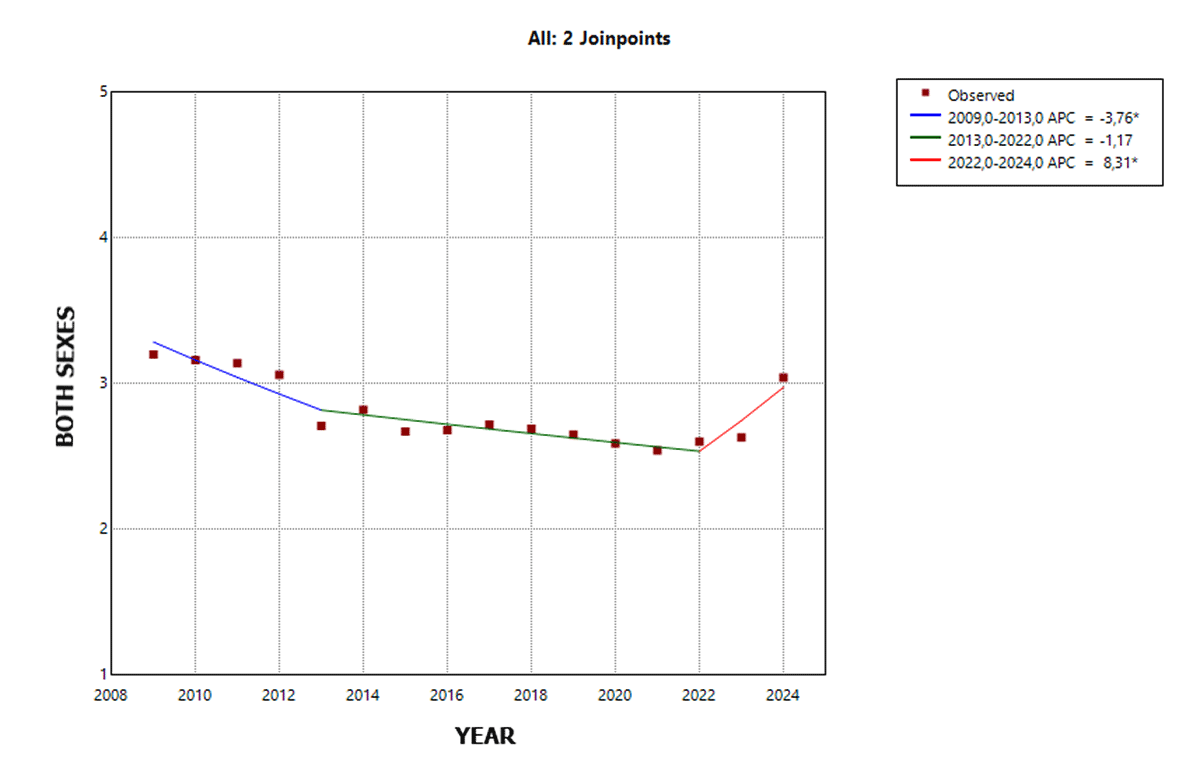
This final segment reverses the previous downward trend and suggests a recent change in the temporal pattern; however, it should be interpreted as a data-driven result of the joinpoint model rather than a predefined period. The time segments reported throughout this analysis (including sex-specific results) were fully derived from the joinpoint regression procedure, in which joinpoints are selected using the Monte Carlo permutation test to identify statistically significant changes in slope.
In males, a significant decrease was recorded between 2009–2013 (APC = −3.33%, P < 0.05). Subsequently, the trend showed a non-significant change through 2024 (APC = −0.89%), and no statistically significant increase was identified in the final segment according to the selected model.
In females, the same initial decrease was observed (APC = −3.35%; not significant in the displayed model), followed by a period of relative stability. A statistically significant change in trend was identified in 2022 by the joinpoint model, resulting in an increase in the 2022–2024 segment (APC = 7.02%, P < 0.05). It should be noted that sex-stratified analyses were performed independently, allowing joinpoints to be identified separately for each subgroup.
The recent increase in infant mortality in Spain therefore appears more pronounced in females; however, this interpretation is based on subgroup-specific model outputs (Supplementary Material in Joinpoints For Sex and Mortality in the Online Supplementary Document).
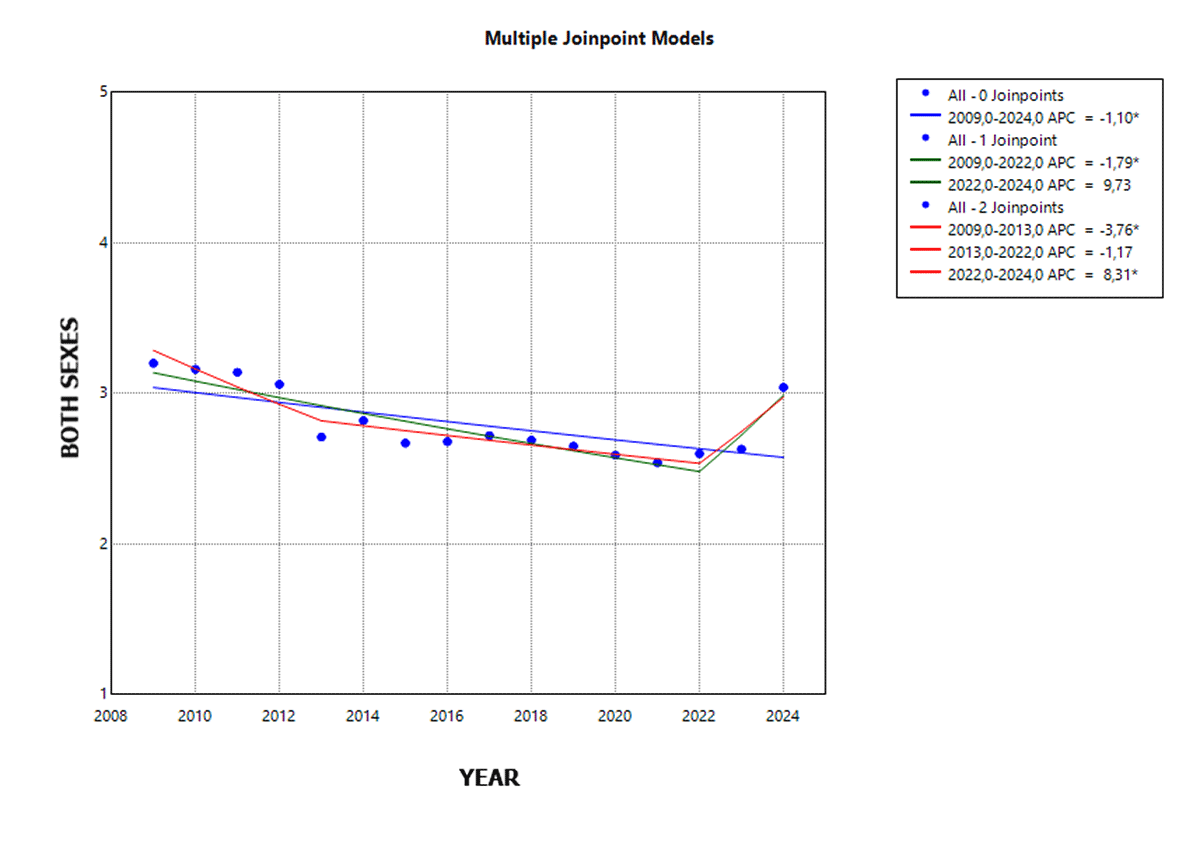
Sensitivity analyses using alternative model specifications (0, 1, and 2 joinpoints) consistently identified a potential change in trend around 2022. In the one-joinpoint model, the post-2022 segment showed an increase (APC = 9.73%), although this was not statistically significant. In the two-joinpoint model, the increase in the 2022–2024 segment remained statistically significant (APC = 8.31%, P < 0.05). These variations indicate that the magnitude and significance of the most recent segment may be sensitive to model specification and should therefore be interpreted with appropriate caution (Figure 2).
Figure 2. Multiple Joinpoints Models. Made by authors. APC – Annual Percent Change.
Neonatal mortality (0–27 days)
The neonatal mortality rate is calculated as the total number of deaths among infants under 28 days of age (from 0 to 27 days), within a specific area, per 1000 live births in that area (Supplementary Table in Neonatal Mortality 2009–2024 in the Online Supplementary Document).
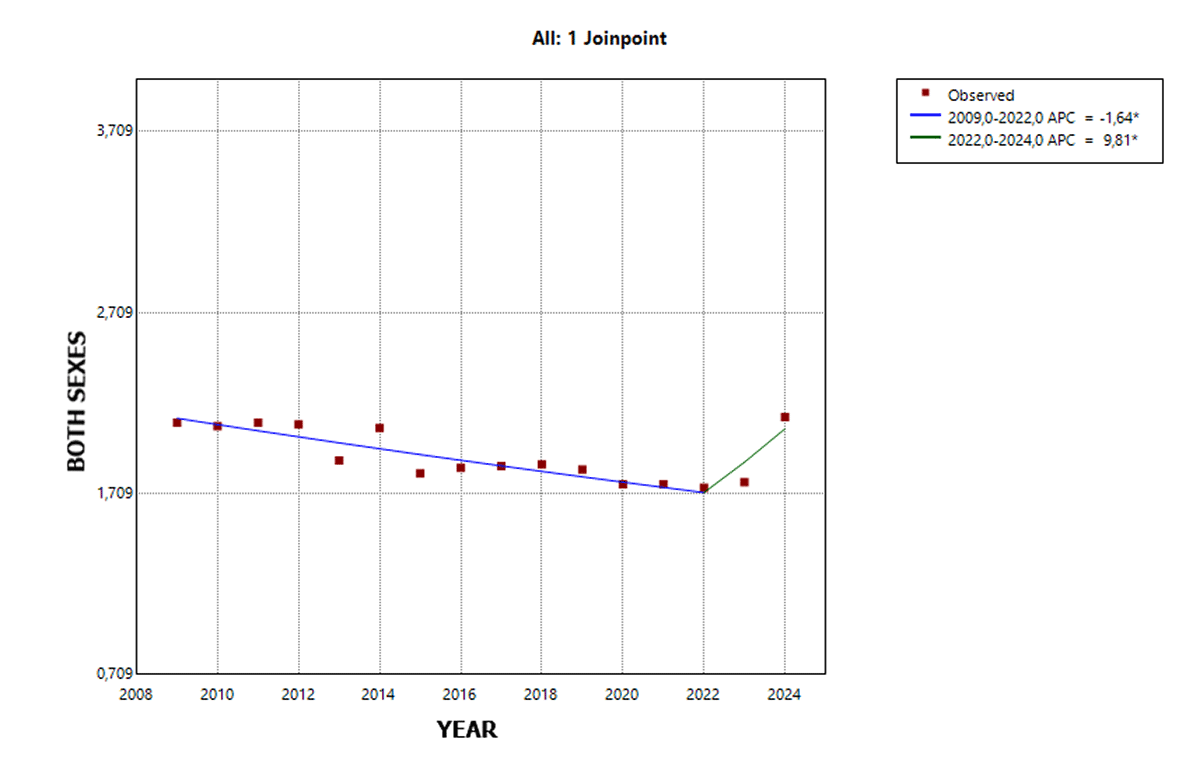
Between 2009–2022, a significant decrease was observed (APC = −1.64%, P < 0.05). After the joinpoint in 2022, a significant annual increase of 9.81% was detected in 2022–2024 (P < 0.05), mirroring the pattern observed in the overall series.
This pattern indicates that the recent overall increase in infant mortality is strongly influenced by the neonatal component (Figure 3).
Figure 3. Neonatal mortality in Spain. Made by authors. *Indicates that the Annual Percent Change (APC) is significantly different from zero at the alpha = 0.05 level. Final selected model: 1 jointpoint. APC – Annual Percent Change.
In the sex-stratified analysis, females showed a prolonged significant decrease (APC = −1.87%, P < 0.05), followed by a non-significant 9.33% increase in the final segment analysed.
Early neonatal mortality (0–6 days)
The early neonatal mortality rate is calculated as the total number of deaths among infants under seven days of age (from 0 to 6 days), in a given area, per 1000 live births in that area (Supplementary Table in Early Neonatal Infant Mortality 2009–2024 in the Online Supplementary Document).
In both sexes, a significant decrease was recorded between 2009–2022 (APC = −0.94%, P < 0.05). Following the joinpoint in 2022, an annual increase of approximately 9% was observed (non-significant overall, but significant in females: APC = 9.02%, P < 0.05).
This suggests that the recent increase particularly affects the early neonatal period.
Late neonatal mortality (7–27 days)
The late neonatal mortality rate is calculated as the total number of deaths among infants under one year of age who are at least 7 days old but less than 28 days old, within a given area, per 1000 live births in that area (Supplementary Table in Late Neonatal Infant Mortality 2009–2024 in the Online Supplementary Document).
A prolonged significant decrease was identified between 2009–2022 (APC = −2.96%, P < 0.05). From 2022 onward, an upward trend was observed (APC 11%), although without statistical significance overall.
Postneonatal mortality (28 days–1 year)
The postneonatal mortality rate is calculated as the total number of deaths among infants under one year of age but older than 27 days, within a specific area, per 1000 live births in that area (Supplementary Table in Postneonatal Infant Mortality in the Online Supplementary Document).
Between 2009–2014, a significant reduction was observed (APC = 6.92%, P < 0.05). After the joinpoint in 2014, the trend (APC = 0.79%, P > 0.05) showed no evidence of a recent significant increase.
Perinatal mortality
The perinatal mortality rate is calculated as the total number of late-term foetal deaths plus deaths of infants under one year of age who are less than 7 days old, among mothers in a given area, per 1000 births (live births plus late-term foetal deaths) in that area (Supplementary Table in Late Fetal Mortality 2009–2024 and Supplementary Table in Perinatal Mortality 2009–2024 in the Online Supplementary Document).
After an initial segment without clear statistical significance, a significant decrease was observed between 2012–2024 (APC = −1.14%, P < 0.05). No recent increase was identified in this indicator.
European comparative analysis
The joinpoint analysis of European countries revealed heterogeneous temporal patterns in infant mortality (Supplementary Table in Infant Mortality 2009–2024 and Supplementary Table in Infant Mortality Eurostat 2013–2024 in the Online Supplementary Document), identifying a small subgroup of countries with a positive Annual Percent Change (APC) in the most recent model-identified segments, specifically Belgium and France. These changes reflect statistically significant inflection points estimated by the joinpoint regression procedure rather than predefined periods.
European countries with a recent statistically significant increase
Belgium showed a change in trend identified by the joinpoint model, with the location of the breakpoint determined data-driven using the Monte Carlo permutation test. A significant decrease was observed between 2019 and 2022 (APC = −8.49%, P < 0.05), followed by an increase in the final segment (2022–2024, APC = 11.86%, P < 0.05). Given the limited number of observations in this last segment, this pattern should be interpreted cautiously as a short-term change in slope estimated by the model rather than evidence of a confirmed structural shift.
France showed a gradual increasing trend across the study period (2013–2023), with a positive and statistically significant APC of +0.895% annually (P < 0.05). In this case, no clear breakpoint was identified by the model, and the increase reflects a sustained long-term slope rather than segmented changes.
It should be noted that the length of the final segment varies across countries depending on the location of model-selected joinpoints and data availability, as the joinpoint procedure does not impose identical time intervals across units of analysis.
Identified pattern typologies
To improve interpretability, countries were classified into three temporal typologies based on the direction, statistical significance, and sequence of APC segments derived from the joinpoint models. ‘Abrupt recent reversal’ was defined as a statistically significant change from a decreasing to an increasing slope in the final model-identified segment, as observed in Belgium. ‘Long-term sustained increase’ referred to countries showing a consistently positive and statistically significant APC over the study period, as in France. ‘Attenuation of decline’ included countries where a previous negative trend became less pronounced without evidence of a statistically significant reversal, as illustrated in countries such as Denmark, Germany, Estonia, and Ireland.
All complementary figures and tables are provided in the Online Supplementary Document.
Effect size and epidemiological relevance
The magnitude of the observed increases is epidemiologically relevant in some contexts; however, interpretation should consider the length and statistical uncertainty of the final model segments. In Belgium, the APC of 11.86% reflects a marked change in slope over a short, model-defined period. In France, the smaller but sustained APC (0.895%) reflects a long-term gradual increase rather than segmented changes.
The observed clustering of inflection points around 2019–2022 in several countries is a model-derived temporal coincidence. While this may suggest shared contextual influences, the ecological design does not allow causal inference, and these patterns should be interpreted as descriptive signals rather than confirmed structural shifts.
DISCUSSION
There appears to be a problem of increasing infant mortality in recent years. The cut-off periods identified in the joinpoint analysis (generally 2019–2022) detect an upward trend not only in Spain but also across neighbouring European countries.
However, this study has several limitations that should be acknowledged. First, the ecological design and the reliance on aggregated national mortality rates preclude adjustment for individual- or population-level covariates and make the findings susceptible to residual confounding. Consequently, the observed trends should be interpreted as descriptive rather than causal, as they may reflect the combined influence of unmeasured factors such as demographic shifts, changes in healthcare access and quality, socioeconomic conditions, and potential variations in mortality registration practices over time. In this context, the joinpoint regression approach identifies temporal inflection points in the data but does not account for underlying determinants of change. Therefore, caution is warranted when attributing the observed patterns to specific mechanisms.
It should also be noted that the most recent segment identified by the joinpoint analysis (2022–2024) covers a relatively short time period. As a result, the corresponding APC estimate should be interpreted with caution, as short segments may be more sensitive to short-term fluctuations. Therefore, these findings likely reflect an emerging pattern that requires confirmation with additional years of data as they become available.
It is also important to note that the downward trend in the number of births in European countries, coupled with a slight increase in the number of deaths, may offer an initial explanation for this phenomenon. However, it is important to consider other potential issues as well.
Related studies on infant mortality, such as that conducted in the US by Gemmill et al. [11] highlight abortion bans in certain US states as a potential causal factor. These findings are echoed in the ecological study by Burdick et al. [12] which also points to maternal smoking and inadequate prenatal care. In any case, this issue connects with the rise of anti-abortion discourse in some European countries, which could influence the decisions of women considering terminating a pregnancy.
However, the problem appears to have a multifactorial origin. In Italy, Simeoni et al. [13] associated the increase in infant mortality with geographic and ethnic factors: children born in southern Italy had a 70% higher probability of death, while children of foreign parents showed a higher likelihood of dying from any cause compared to those of Italian parents.
Ethnicity-related factors have also been studied in the United States. The report Infant Mortality in the United States, 2021: Data From the Period Linked Birth/Infant Death File [14] emphasises this issue, with particular focus on conditions related to low birth weight and prematurity. Another factor highlighted in this report is maternal age, pointing to an additional element that may help explain the findings of our study.
Inequity in access to basic services has also been described as a relevant contributing factor [15]. Furthermore, several studies have linked low levels of maternal education with increased infant mortality [15,16].
However, most of these highlighted factors do not primarily focus on Europe, which has long been considered a central context of Western society. The welfare state has been affected since the 2008 economic crisis, as evidenced in studies such as that by Vlachadis et al. [17] which confirmed a shift in the trend of infant mortality rates during the period 2008–2016.
These findings are consistent with those observed in our study. The COVID-19 pandemic appears to have had consequences across all spheres of society, with notable economic effects and a clear deterioration of public healthcare systems, which are characteristic of the context under study. In Spain, for example, a shift in the perception of the healthcare system has been observed: data from 2025 show an average satisfaction score of 6.15 out of 10.16 representing a decline since the pandemic (2022: 6.25; 2023: 6.22; 2024: 6.22), and an even more pronounced decrease compared to the pre-COVID-19 period, when the average score in 2019 was 6.74.
These findings are corroborated by general satisfaction surveys, in which up to 2019, 72.1% of respondents reported that the system was functioning fairly well or well, albeit with a need for some changes. This figure has decreased by nearly 20 percentage points, reaching 53.9% in the 2025 survey [18,19].
Considering these factors, it is striking that no previous studies have specifically addressed this issue in a way that raises concern or alerts about the increase in infant mortality within the Spanish or broader European context [20].
In a context of clearly declining birth rates across European Union countries, Spain being one of the most affected, there is an urgent need to implement public health policies aimed at explaining and addressing this phenomenon. The combined effect of declining birth rates and increasing infant mortality may have significant medium- and long-term consequences. First, the association between socioeconomic characteristics and risk factors for child mortality has already been established, which may be directly relevant to the situation in Spain [18]. Although data show a 3.1% reduction since 2016, the proportion remains substantial, representing approximately one-quarter of the Spanish population, with a rate of 25.7% in 2025 according to the National Institute of Statistics [21].
From a broader socioeconomic perspective, the impact of infant mortality is undeniable in social terms and, consequently, in long-term economic outcomes. The shift in the population pyramid observed in Western contexts is well known and is closely linked to the future sustainability of welfare state policies, critical in European societies, which may be significantly affected by an increase in infant mortality rates.
All of these elements converge on a common factor: delayed maternal age. Socioeconomic challenges, the deterioration of healthcare systems following the pandemic, and cultural changes have contributed to a clear postponement of motherhood in Spain. According to 2024 data from the National Institute of Statistics, Spain’s fertility rate declined to 1.10 children per woman, continuing the trend observed since the beginning of the century. At the same time, the mean age at first childbirth has reached 32.6 years, with 10.4% of births occurring in mothers over 40 years of age. Additionally, 39.6% of births are to mothers aged 35 years or older [22].
This phenomenon has already been analysed [3], concluding that significant differences exist between maternal age and infant mortality rates. Alongside this, economic factors [23] appear to play a key role. Both have been identified as factors associated with maternal age [24], establishing it as a relevant risk factor.
The observed increase in infant mortality calls for urgent action by public institutions, both in Spain and across Europe, to investigate the underlying causes and address them as promptly as possible. This is essential to prevent a gradual rise with clear consequences not only for the physical health of mothers and neonates, but also for the mental health of families experiencing child loss, and for European societies as a whole, which may face emerging socioeconomic challenges.
CONCLUSIONS
Evidence before this study
Infant mortality in Europe has shown a general decline over recent decades, yet evidence from Eurostat and national statistical agencies indicates that this trend has slowed or plateaued in several countries since 2009. Prior studies have highlighted disparities in neonatal and postneonatal mortality, the impact of gestational age, social and territorial inequalities, and differences in perinatal care organisation. However, most analyses have not specifically focused on recent trends in Spain or the combined European context using joinpoint regression to identify changes in temporal trends.
Added value of this study
This study provides a detailed joinpoint analysis of infant mortality trends in Spain and compares these with other European countries. We identify recent structural changes in temporal trends, including a significant increase in infant mortality rates in the most recent years, primarily driven by the female and neonatal components. Our findings highlight heterogeneity between countries and pinpoint specific inflection points, which previous studies did not quantify.
Implications of all the available evidence
The observed upward trends in infant mortality, particularly in Spain, highlight the need for urgent public health attention. Policy makers should focus on maternal and neonatal care interventions, monitoring social inequalities, and revising perinatal care pathways. The European comparative perspective suggests that broader systemic factors may be contributing to these changes, emphasising the importance of cross-national surveillance and targeted research to mitigate rising infant mortality.