

Adolescents remain vulnerable in a world of rapid globalisation and digital transitions. The second Lancet Commission on adolescent health and well-being indicates that by 2030, at least 50% of the world’s adolescents will live in multi-burden countries where they face multiple, overlapping health burdens, with adolescents in all countries increasingly affected by emerging challenges such as overweight and obesity, mental disorders, and suicide [1]. Despite the significance of this critical developmental stage, adolescents are underrepresented in most national strategies, which threatens the achievement of many Sustainable Development Goals (SDGs) [2–8].
Adolescent health is profoundly influenced by social factors at the personal, family, community, and national levels, among which structural determinants (e.g. social systems and the wider development landscape) are considered to have the most significant and far-reaching effects [9,10]. The biological and socialisation processes that underpin healthy adolescent development are powerfully shaped by external environments. Supportive societies empower and protect adolescents, while adverse contexts and inequality impose substantial constraints on adolescents’ opportunities and potential [2,9,11–13]. Notwithstanding studies examining the social determinants of adolescent health [11,14], critical gaps persist. Most studies focus on individual-level determinants; few have explored how country-level development across multiple dimensions affects adolescent health, particularly beyond economic development. Moreover, while existing research highlights improvements in some areas like HIV, a limited intersectoral perspective and lack of global data coverage have resulted in widespread neglect of newer health concerns, such as violence and mental health [15].
A recent review in Lancet Planetary Health proposed a multidimensional framework on well-being, inclusion, and sustainability to better capture the relationships between structural social determinants and health, emphasising long-term and intergenerational equity [16]. This approach is especially relevant for adolescents, whose health today drives future societal health and well-being [17]. Using this multidimensional framework of well-being (human development index (HDI)), inclusion (gender inequality index (GII)), and sustainability (adjusted net savings (ANS)), we quantified the associations of these three dimensions with the adolescent health burden across 193 countries in 2010, 2021, and with projections to 2035. We analysed all-cause disability-adjusted life years (DALYs) from the Global Burden of Disease (GBD) 2021 database (including DALY estimates from 2010 to 2021 and forecasts in 2035), with development indicators sourced from the United Nations Development Programme (UNDP) (HDI and GII) and the World Bank (ANS) [18,19]. Specifically, we aimed to: determine the global, regional and national trends of disease burden among adolescents aged 10–24 years [20], determine the relative contributions of HDI, GII, and ANS to the adolescent disease burden, and examine temporal trends in these associations across the period of global social transformations that is marked by interconnected economic and cultural change, rapid technological advancement, and epidemiological transitions. We aimed to identify which dimensions are becoming increasingly critical for adolescent health policymaking, ultimately promoting inclusive and sustainable well-being for the next generation. We followed the GRABDROP guidelines (Table S1 of the Online Supplementary Document) [21].
METHODS
Overview
We applied a global ecological design. We used GBD 2021 data for past estimates from 1990 to 2021 and GBD forecasting data for 2035. We accessed the HDI, GII, and ANS values from 1990 to 2021 from online databases, and projected the 2035 values using the autoregressive integrated moving average (ARIMA) model. We focused on 193 countries and territories based on data availability and quality (Table S2 in the Online Supplementary Document). We performed descriptive and log-linear regression analyses to examine the associations between each dimension and adolescent DALYs between 2010 and 2021, and further conducted scenario analyses through 2035.
DALYs
The DALY is a composite metric of years of life lost and years lived with disability, enabling a comprehensive assessment of fatal and non-fatal health loss across diseases and capturing broader impacts on multimorbidity and functional health status [22]. We obtained annual DALYs from 2010 to 2021 per 100 000 population were obtained from the GBD 2021 Results Tool (Institute for Health Metrics and Evaluation, University of Washington, Seattle, Washington, USA) at the country level, while we obtained the predicted DALYs in 2035 from GBD foresight. GBD 2021 produced the estimates of DALYs for 371 diseases and injuries by sex, age, and year in 204 countries and territories [23]. The details of GBD 2021 have been published elsewhere [23]. In brief, the 371 diseases and injuries were organised within a four-level cause hierarchy, with level one comprising four broad aggregate categories (communicable, maternal, neonatal, and nutritional diseases (CMNNs); non-communicable diseases (NCDs); injuries; and other COVID-19 pandemic-related outcomes). These level-1 categories are further classified into 22 level-2 categories. Given data availability and consistency, we included only the first three level-1 categories (CMNNs, NCDs, and injuries). We used meta-regression-Bayesian, regularised, trimmed, and Disease Modelling Meta-Regression, version 2.1 (Institute for Health Metrics and Evaluation, University of Washington, Seattle, Washington, USA), as well as Cause of Death Ensemble model (Institute for Health Metrics and Evaluation, University of Washington, Seattle, Washington, USA) to estimate the DALYs by location, age, sex, year, and cause between 1990 and 2021. We generated the 2035 estimates were generated using an ARIMA model with decaying drift and an exogenous variable, the socioeconomic development index (SDI) [24].
We considered age-standardised all-cause and cause-specific (level 2) DALY rates (per 100 000 population) among those aged 10–24 years in both sexes as the primary outcome. To minimise the influence of differences in age structure across countries and to improve cross-country comparability of adolescent health burden, we age-standardised all-cause and level-two-cause-specific DALY rates in 2010, 2021, and 2035 for both sexes and all locations to generate the age-standardised DALY rates (ASDRs) using the world population structure 2021 as reported by GBD [25].
Well-being, inclusion, and sustainability
The HDI, representing well-being, is a commonly used measure of population development created by the UNDP based on three key dimensions – a long and healthy life, knowledge, and decent living, which were calculated using life expectancy at birth, mean years and expected years of schooling, and gross domestic product (GDP) per capita, respectively [18]. The GII, representing inclusion, is a well-acknowledged indicator reflecting population-level gender inequities also created by the United Nations (UN), which includes three important dimensions – reproductive health (represented by maternal mortality and adolescent birth rate), empowerment (represented by the proportion of men and women with at least some secondary education and the proportion of men and women occupying parliamentary seats), and economic status (labour market participation among men and women) [19]. The detailed calculation processes for the HDI and GII are presented in the Human Development Report 2023/2024 Technical Notes published by UNDP. The data centre of the UNDP Human Development Reports provides the HDI and GII, along with their components, for 195 countries from 1990 to 2022. The ANS, representing sustainability, is a widely used measure of national economic sustainability developed by the World Bank, defined as net investment in produced capital plus public education expenditure minus natural resource depletion and damage from carbon dioxide and particulate emissions [26]. The World Bank’s database provides the ANS and its components, measured by annual percentage growth or in constant 2015 USD. We used the former measurement in this study.
To generate the forecast estimates of the HDI, GII, and ANS in 2035, we applied an ARIMA model for every component of these indicators to gain their future estimates, which were then calculated according to the technical directions from the UNDP and World Bank to produce the forecast HDI, GII, and ANS in 2035.
Country groups
We divided countries into three groups based on the excess adolescent disease burden representing different stages of the epidemiological transition, according to the definitions from the 2016 and 2025 Lancet Commissions on Adolescent Health and Well-being [1,17]. The groupings in this study are based on the DALY rate for adolescents aged 10–24 years in 2021 and are applied consistently across analyses. We defined countries as multi-burden if adolescents aged 10–24 years had a burden of CMNN diseases ≥2500 DALYs per 100 000, injury excess if adolescents were estimated to have ≥2500 DALYs per 100 000 due to injury and <2500 DALYs due to CMNN, and NCD predominant if both injuries and CMNN each contributed <2500 DALYs per 100 000 to the disease burden (Table S2 of the Online Supplementary Document). To delve further into the association between the adolescent health burden and its different dimensions, we also divided countries into Global North and Global South groups based on the list provided by the UN Finance Centre for South-South Cooperation.
Statistical analysis
We estimated annual percentage change (APC) by fitting a log-linear regression model to the ASDRs or their male-to-female ratios over the period 2010–2021. We employed log-linear regression models to quantify cross-sectional associations between sustainable development dimensions (HDI, GII, and ANS) and ASDRs (all-cause and level-2 cause-specific) at two time points (2010 and 2021), and further conducted scenario analyses to 2035. Before analysis, we standardised all predictors (Z-scores). The model was specified as ln (ASDR) = β0 + β1HDI + β2GII + β3ANS + ϵ.
We exponentiated the coefficients to obtain rate ratios (RRs) representing the multiplicative change in ASDR per one-standard-deviation increase in each predictor. Robust standard errors accounted for heteroskedasticity. We calculated variance inflation factors (VIFs) to assess multicollinearity among indicators. Further, we conducted subgroup analysis in the three country groups and the Global North/South groups. To capture the evolving associations of the three dimensions with adolescent health burdens, temporal trends in these associations were assessed by fitting log-linear regression models of RRs on calendar year (2010–2021). We derived the APC, and the corresponding P-values from these models to evaluate the statistical significance of trends over time.
We conducted sensitivity analyses to assess the robustness of the findings. First, we performed age-stratified analyses (10–14, 15–19, and 20–24 years) to examine consistency across age groups. Second, we re-estimated models with regional fixed effects to account for unobserved spatial heterogeneity. Third, we conducted lagged analyses (one to three years) and restricted cubic spline analysis to evaluate potential delayed and nonlinear associations between HDI, GII, ANS, and ASDR. Finally, we performed sex-stratified analyses and tested interaction terms between sex and each indicator to assess potential effect modification. We conducted all analyses in R, version 4.4.2 (R Core Team, Vienna, Austria), and P < 0.05 was considered statistically significant.
RESULTS
Global trends in all-cause DALYs from 2010 to 2035
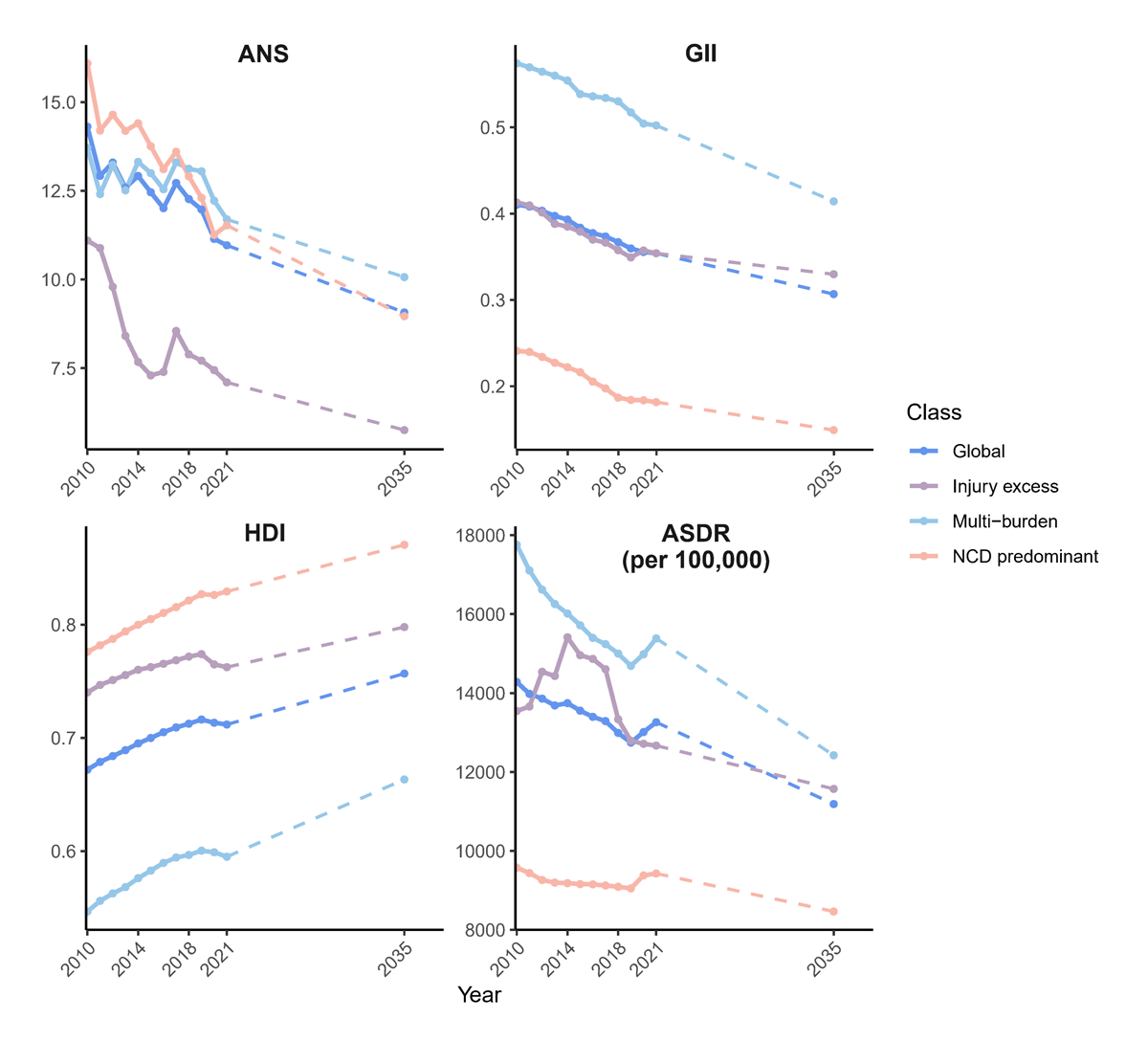
The global all-cause ASDR in adolescents aged 10–24 years exhibited a downward trend from 2010 (ASDR = 14 280.1; 95% uncertainty interval (UI) = 14 264.3, 14 296.0 per 100 000) to 2021 (ASDR = 13 260.5; 95% UI = 13 245.2, 13 275.8 per 100 000), with an APC of –0.85% (95% confidence interval (CI) = –1.12, –0.58), and is forecast to decline (ASDR = 11 187.7; 95% UI = 11 173.8, 11 201.6 per 100 000) in 2035. Across the three country groups, the all-cause ASDR corresponded with global trends. Multi-burden countries continued to have the highest adolescent health burden of the three groups. The ASDR decreased from 17 755.7 (95% UI = 17 739.6, 17 771.8) per 100 000 population in 2010 to 15 384.3 (95% UI = 15 370.0, 15 398.6) per 100 000 population in 2021 (APC = –1.47; 95% CI = –1.93, –1.01), and is forecast to decline to 12 423.2 (95% CI = 12 410.5, 12 435.84) per 100 000 in 2035. The ASDR in NCD predominant countries remained relatively stable as the lowest among the three groups, with a slight decrease from 2010 (ASDR = 9575.5; 95% UI = 9561.6, 9589.4 per 100 000) to 2021 (ASDR = 9427.8; 95% UI = 9412.7, 9442.9 per 100 000), indicating a non-significant change (APC = –0.16; 95% CI = –0.49, 0.16), that is forecast to reach 8464.2 (95% UI = 8450.0, 8478.4) per 100 000 in 2035. (Figure 1; Table S2 in the Online Supplementary Document)
Figure 1. Trends in all-cause age-standardised DALY rate, HDI, GII, and ANS in 193 countries, 2010–2035.
Global trends in well-being, inclusion, and sustainability from 2010 to 2035
The HDI progressed globally from 2010 (HDI = 0.67) to 2021 (HDI = 0.71), and is forecast to continue increasing to 2035 (HDI = 0.76). Similar trends were found in multi-burden (2010 HDI = 0.55, 2021 HDI = 0.59, and 2035 HDI = 0.66), injury excess (2010 HDI = 0.74, 2021 HDI = 0.76, and 2035 HDI = 0.80), and NCD predominant countries (2010 HDI = 0.78, 2021 HDI = 0.83, and 2035 HDI = 0.87). The GII declined globally from 2010 (GII = 0.41) to 2021 (GII = 0.35) and is forecast to continue declining through 2035 (GII = 0.31), reflecting an improvement in the inclusion dimension. Similar trends were found in multi-burden countries (2010 GII = 0.57, 2021 GII = 0.50, and 2035 GII = 0.41, the highest group) and NCD-predominant countries (2010 GII = 0.24, 2021 GII = 0.18, and 2035 GII = 0.15, the lowest group). In contrast to these two indicators, the ANS exhibited greater volatility, with ANS in injury-excess countries significantly lower than in the other two country groups. Globally, the ANS showed a downward trend from 2010 (ANS = 14.31) to 2021 (ANS = 10.96) and is forecast to continue declining through 2035 (ANS = 9.07). The decline was most pronounced in NCD predominant countries (2010 ANS = 16.09, 2021 ANS = 11.53, and 2035 ANS = 8.96), while the decrease in multi-burden countries was relatively modest (2010 ANS = 13.70, 2021 ANS = 11.70, and 2035 ANS = 10.07). (Figure 1; Table S3 in the Online Supplementary Document)
Regional and national patterns of DALYs and average change from 2010 to 2035
In 2021, the highest all-cause DALY burden among adolescents was concentrated in Sub-Saharan Africa and certain low-income regions; 14 countries (7% and all from the multi-burden group) exhibited ASDRs exceeding 20 000 per 100 000. The highest ASDRs were documented in Afghanistan (ASDR = 38 224.7; 95% UI = 38 187.0, 38 262.3), Lesotho (ASDR = 32 679.9; 95% UI = 32 536.8, 32 823.6), and the Central African Republic (ASDR = 31 303.6; 95% UI = 31 221.2, 31 386.3). Those countries also experienced substantial gender disparity, with the male-to-female ASDR ratio of 1.87 in Afghanistan, 1.13 in Lesotho, and 1.40 in the Central African Republic. In contrast, the lowest burden was observed in East Asia and Europe, with 51 countries (26% and 49 NCD-predominant countries and two injury-excess countries) reporting ASDRs below 10 000 per 100 000. Three NCD predominant countries, namely China (ASDR = 7515.8; 95% UI = 7512.3, 7519.4), Singapore (ASDR = 7716.8; 95% UI = 7653.2, 7780.7), and the Republic of Korea (ASDR = 7778.6; 95% UI = 7759.0, 7798.2) demonstrated the most favourable outcomes. (Figure 2; Figure S1 in the Online Supplementary Document)
Figure 2. Regional patterns of all-cause ASDR in 2021 (Panel A) and APC in 2010–2021 (Panel B) for 193 countries.
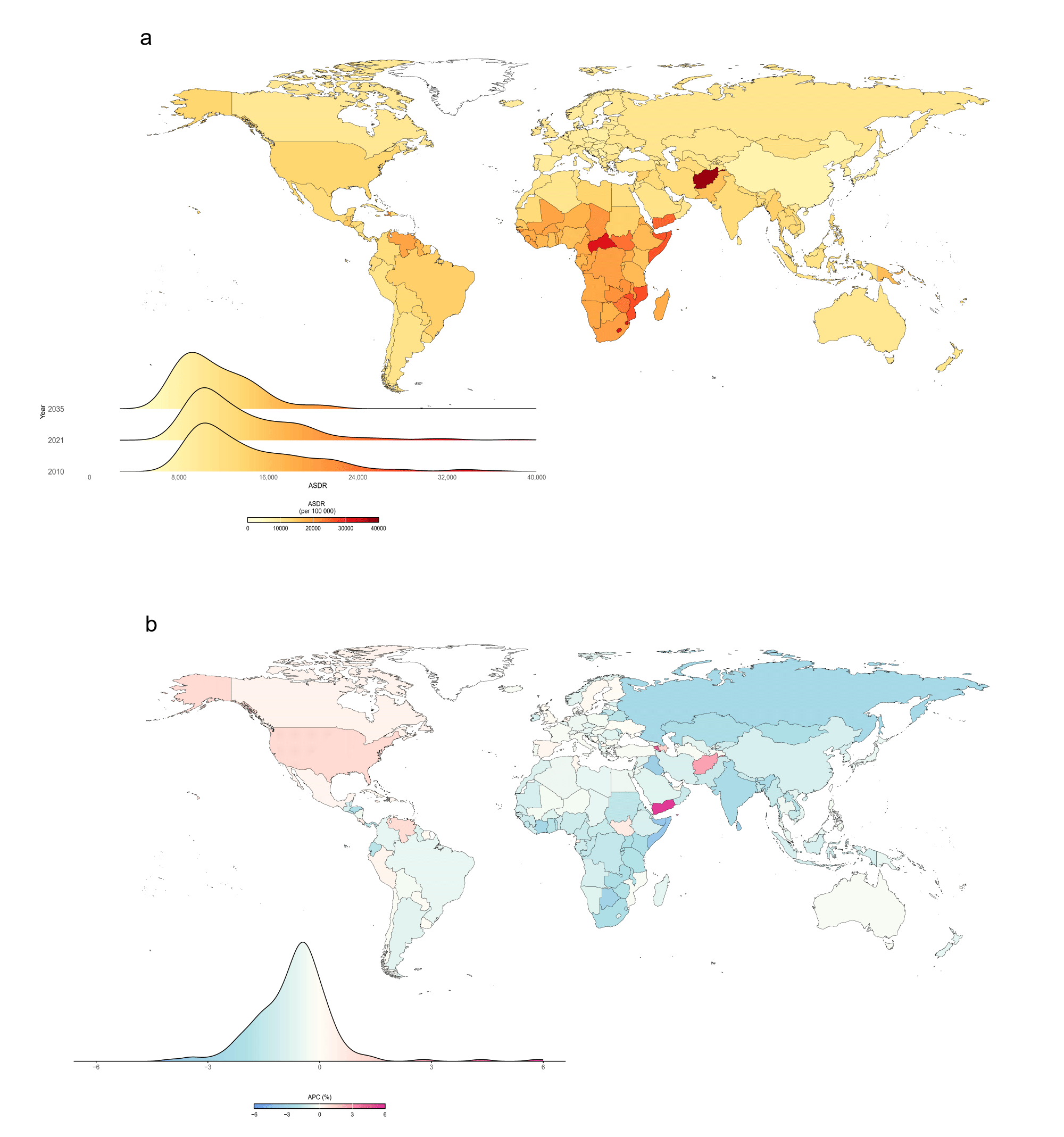
From 2010 to 2021, 109 of 193 (56%) countries exhibited a significant decline in the ASDR, mainly among multi-burden countries, with the sharpest drops observed in Somalia (APC = –4.0; 95% CI = –7.5, –0.5) %), Sri Lanka (APC = –3.4; 95% CI = –6.0, –0.9), and Botswana (APC = –3.0; 95% CI = –3.8, –2.3). In contrast, only eight of 193 (4%) countries experienced significant increases, half of which were from the NCD predominant group, namely the USA (APC = 1.3; 95% CI = 0.7, 1.8), Mauritius (APC = 0.9; 95% CI = 0.8, 1.0), Jamaica (APC = 0.7; 95% CI = 0.0, 1.5), and Canada (APC = 0.3; 95% CI = 0.1, 0.6). (Figure 2; Figure S1 in the Online Supplementary Document)
Association between all-cause DALYs and HDI, GII, and ANS from 2010 to 2035
Across all models, VIF values for each indicator were <5, indicating no significant multicollinearity among the HDI, GII, and ANS. Overall, the HDI exhibited significant, weakening negative associations, whereas the GII showed significant, strengthening positive associations with all-cause ASDR among adolescents globally. From 2010 to 2021, the association between HDI and all-cause ASDR appeared to attenuate (RR = 0.79; 95% CI = 0.74, 0.84 in 2010 vs. RR = 0.84; 95% CI = 0.79, 0.89 in 2021), and the projected estimate for 2035 (RR = 0.92; 95% CI = 0.88, 0.96) suggested a further attenuation in the scenario analysis. The association between GII and all-cause ASDR was slightly higher in 2021 (RR = 1.11; 95% CI = 1.06, 1.17) than in 2010 (RR = 1.09; 1.02, 1.15), and the projected estimate for 2035 (RR = 1.15; 95% CI = 1.11, 1.20) suggested strengthening in scenario analysis. No significant association was observed between ANS and ASDR in 2010 or 2021, and the projected estimate for 2035 likewise suggested no clear association in scenario analysis. (Figure 3; Table S4 in the Online Supplementary Document)
Figure 3. Association of all-cause ASDR with HDI, GII, and ANS in different country groups in 2010, 2021,2035.
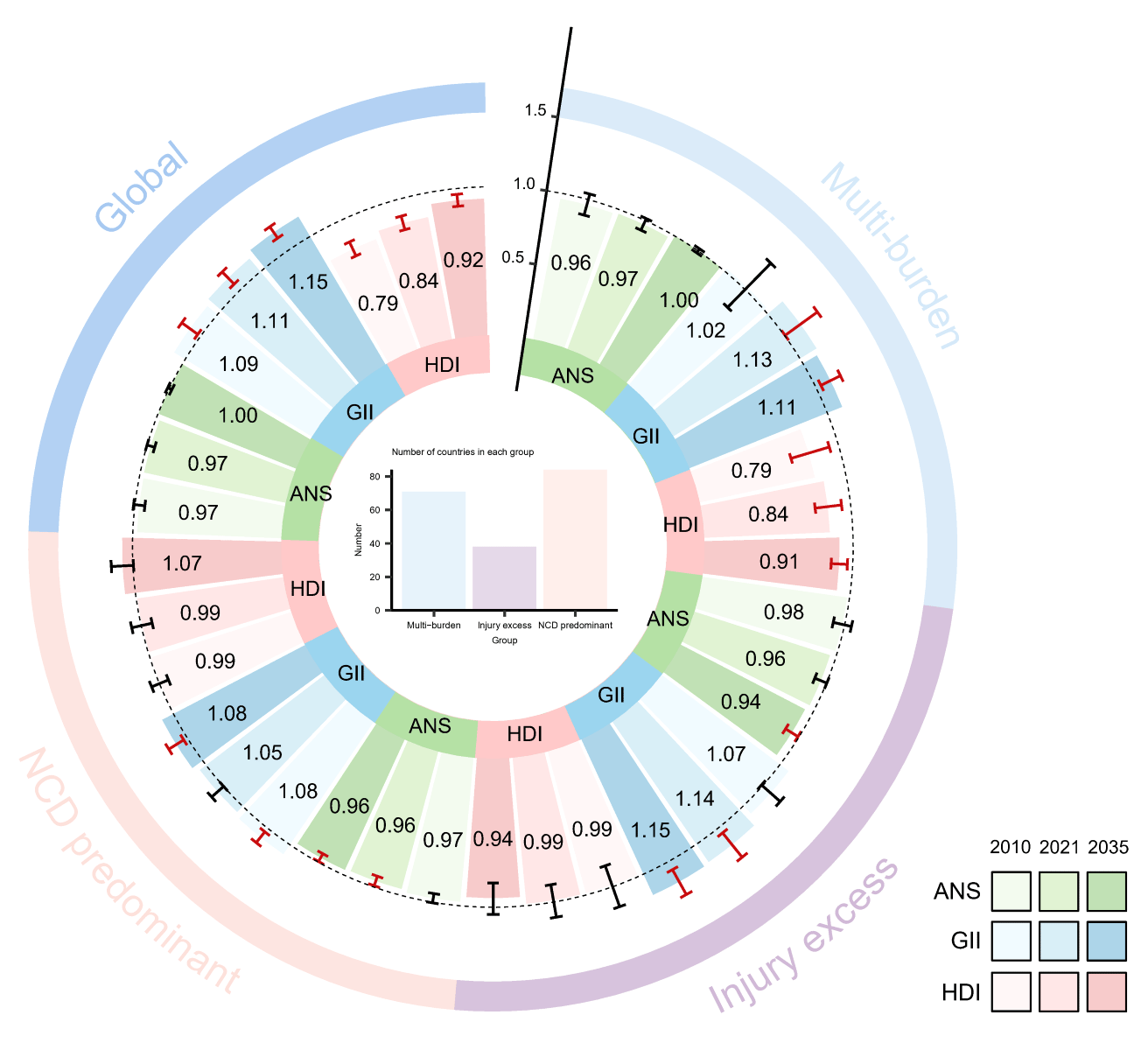
In both multi-burden and injury excess countries, the association between GII and ASDR appeared to strengthen between 2010 (RR = 1.02; 95% CI = 0.83, 1.25 and RR = 1.07; 95% CI = 0.99, 1.16) and 2021 (RR = 1.13; 95% CI = 1.00, 1.27 and RR = 1.14; 95% CI = 1.04, 1.26), which was also validated in the scenario analysis (RR = 1.11; 95% CI = 1.04, 1.18 and RR = 1.15; 95% CI = 1.06, 1.25) (Figure 3; Table S4 and S9 in the Online Supplementary Document). Global North and Global South countries exhibited distinct patterns. In Global North countries, the HDI was not significantly associated with all-cause ASDR in most periods, whereas GII exhibited a progressively stronger positive association from 2010 (RR = 1.15; 95% CI = 1.07, 1.22) to 2021 (RR = 1.19; 95% CI = 1.10, 1.28). In the 2035 scenario analysis, the association between GII and ASDR remained significant in Global North countries (RR = 1.16; 95% CI = 1.08, 1.24). The ANS was not significantly associated with ASDR in Global North countries in either 2010 or 2021, nor in the 2035 scenario analysis. In contrast, Global South countries showed a consistent negative association between HDI and all-cause ASDR across all years, with the magnitude remaining relatively stable over time (RR = 0.78; 95% CI = 0.72, 0.85 in 2010 and RR = 0.82; 95% CI = 0.76, 0.87 in 2021). Meanwhile, the association between GII and all-cause ASDR remained relatively stable in Global South countries (RR = 1.10; 95% CI = 1.01, 1.20 in 2010 and RR = 1.12; 95% CI = 1.05, 1.20 in 2021). The ANS showed a significant association with ASDR in 2021 (RR = 0.95; 95% CI = 0.93, 0.99), but no consistent trend in the association was found. In the 2035 scenario analysis, these trends were also validated in Global South countries (for HDI RR = 0.91; 95% CI = 0.87, 0.96, for GII RR = 1.14; 95% CI = 1.09, 1.20, and for ANS RR = 0.99; 95% CI = 0.98, 1.01) (Figure S2 and Table S4 in the Online Supplementary Document)
Sensitivity analyses yielded results consistent with the main findings. Age-stratified analyses and models adjusted for regional fixed effects showed associations similar to those in the primary analyses (Tables S6 and S7 in the Online Supplementary Document). The lagged analyses showed that ANS was negatively associated with the adolescent health burden in 2010 and 2021, with a significant association in 2010 at lag of one year (RR = 0.95; 95% CI = 0.91, 0.99) and in 2021 across all lag specifications. In scenario analyses for 2035, significant associations between ANS and ASDR were observed at a lag of three years (RR = 0.96; 95% CI = 0.93, 0.98) (Table S8 in the Online Supplementary Document). A significant nonlinear relationship was consistently observed for HDI in 2010, 2021, and 2035 (P < 0.01), and for ANS in 2021 (P = 0.002), whereas no evidence of nonlinearity was found for GII. In sex-stratified analyses, the associations were comparable between males and females, and no statistically significant interaction effects were observed (Figure S3 and Table S10 in the Online Supplementary Document).
Associations between DALYs caused by different level 2 causes and HDI, GII, and ANS
In analyses of 2010 and 2021, with scenario projections for 2035, the associations of HDI, GII, and ANS with ASDR in 10–24-year-olds showed distinct patterns across different level 1 and level 2 causes. The HDI showed a declining negative association with CMNNs, but a positive association with specific NCDs. The GII showed associations across disease categories and the ANS maintained significant associations with limited level 2 causes. (Figure S4 and Table S5 in the Online Supplementary Document)
For CMNNs, the association between HDI and ASDRs attenuated over time, with RRs increasing from 0.40 (95%CI = 0.36, 0.45) in 2010 to 0.47 (95% CI = 0.42, 0.54) in 2021, and further to 0.60 (95% CI = 0.54, 0.66) in 2035 in the scenario analysis. In contrast, the association between GII and ASDRs remained stable between 2010 (RR = 1.17; 95% CI = 1.05, 1.30) and 2021 (RR = 1.19; 95% CI = 1.06, 1.32), but became stronger in 2035 (RR = 1.35; 95% CI = 1.22, 1.48) in the scenario analysis. For NCDs, stable associations between HDI, GII, and ANS and ASDR were observed from 2010 to 2021. For injuries, a stable association between GII and ASDR was found between 2010 (RR = 1.27; 95% CI = 1.12, 1.44) and 2021 (RR = 1.36; 95% CI = 1.21, 1.53). (Figure S4 and Table S5 in the Online Supplementary Document).
DISCUSSION
The future lives of adolescents are closely and deeply linked to inclusive and sustainable well-being. To our knowledge, this ecological study is the first to integrate data from the GBD database, the UNDP, and the World Bank to reveal the evolving associations of health burdens in 10–24-year-olds with three indicators representing well-being (HDI), inclusion (GII), and sustainability (ANS) from 2010 to 2021, with forecasts to 2035 in the scenario analysis. We found divergent trends in adolescent health across different aspects of national development. The most substantial reductions in disease burden were observed in multi-burden countries, whereas several high-income regions experienced stagnating or even increasing burdens over time. Interestingly, countries with higher adolescent health burdens also tended to exhibit greater male-to-female disparities in ASDR. The association between the HDI and health burden was attenuated with national development, whereas the GII demonstrated progressively stronger associations over time and with the spectrum of national development. Cause-specific analyses showed that the HDI was primarily associated with CMNNs, the GII developed broadening associations with CMNNs, NCDs, and injuries, while the ANS showed emerging associations with ASDR in injury-excess countries and NCD-predominant countries. These findings indicate that, as the epidemiological transition of adolescent health burden occurs with socioeconomic development around the globe, greater attention should be directed toward fostering inclusion to ensure that the health needs of all adolescents are recognised and addressed in research and policy. Strengthening inclusion may help reduce inequities and support more equitable and sustainable health strategies in the years ahead.
Changes in adolescent DALYs across different regions
Across the spectrum of national development, adolescent health burdens follow divergent trends. While some countries have seen gains alongside socioeconomic progress, others, particularly conflict-affected regions, face persistently high burdens. Emerging NCD threats and the impact of COVID-19 further compound these challenges, underscoring the need to examine disparities, including those linked to gender inequalities [1]. Our sex-disaggregated analysis echoed this concern, revealing elevated male-to-female ASDR ratios in high-GII countries across the spectrum of national development, from multi-burden countries like Yemen to high-HDI countries like Brazil. These findings highlight the potential value of multidimensional frameworks, including gender equity and broader determinants than economic indicators, when addressing the adolescent health burden. Indeed, recent research on women’s health and well-being has explicitly articulated similar concerns, proposing a life-course, multidimensional metric framework that not only evaluates progress and challenges in women’s welfare but also helps identify exemplar countries whose trajectories can inform policy elsewhere [27].
Associations between DALYs and beyond GDP indicators
The inclusion dimension, as represented by the GII, showed a strong relationship with the adolescent disease burden, highlighting an important yet underdeveloped frontier in adolescent health research. From the life course perspective, health differences between men and women begin in adolescence, when pubertal changes and gender socialisation gain prominence and largely coincide with the development of gender gaps [28–30]. Our findings additionally highlight that gender inequality has had an increasingly pronounced association with adolescent health over time, particularly in multi-burden and injury-excess countries. The associations between inclusion and the adolescent health burden were stable for NCDs and injuries during 2010 and 2021. These associations are not yet sufficiently recognised within discussions of gender and health, but they are increasingly relevant in low-, middle-, and high-income countries [29]. Emerging evidence has linked gender norms with the potential risk of mental illness, chronic disease, and violence, reinforcing the need to address gender inequality within diverse health domains [28,31–34]. Inclusive policies that affirm gender diversity and promote safe, equitable environments have been linked to reduced psychological distress among adolescents [35,36]. This suggests that addressing gender inequalities during adolescence is not only an ethical imperative but also a strategic investment in long-term health [37]. Despite this growing recognition, conceptual clarity, definitions, and measurement tools for inclusion remain underdeveloped and poorly standardised [38]. The lack of robust, comparable indicators for equity and inclusion hampers the ability to assess progress and design targeted interventions. Establishing stronger measures of equity and inclusion, including those most relevant for adolescents, could help resolve definitional ambiguities, enable systematic evaluation, and guide policy actions to create safer, more equitable environments for healthier, more empowered generations.
The well-being dimension, represented by the HDI, showed significant negative associations with all-cause DALYs among adolescents globally, with the association most pronounced in multi-burden and Global South countries. This pattern is consistent with the observed nonlinear relationship, in which the inverse association between HDI and ASDR was stronger at lower HDI levels and tended to plateau as HDI increased. This trend also corresponded with the cause-specific analysis, which indicated that the HDI was primarily associated with CMNN diseases – a major contributor to the adolescent disease burden in multi-burden countries. High-HDI countries tend to ensure comprehensive coverage of essential health services, sanitation, food security, and human resources for health, conditions associated with lower burdens of CMNN diseases [10,39,40]. The most typical example is observed in neglected tropical diseases and malaria, which exhibited the strongest correlation with the HDI. These diseases predominantly cluster in regions characterised by extreme poverty and low socioeconomic status, where health care and access to clean water remain severely deficient. This disease burden further exacerbates poverty through lost productivity and high medical costs [41,42]. However, for some diseases, such as mental disorders and substance use disorders, higher HDI is correlated with a higher disease burden, which warrants further attention [43–45]. In the main analyses for 2010 and 2021, the association between HDI and all-cause ASDR appeared to attenuate as the epidemiological transition progressed, a pattern also observed in the scenario analyses for 2035. Although these scenario analyses may be affected by potential circularity within the GBD forecasting framework due to the overlap between HDI and SDI, this pattern nevertheless highlights the need to expand existing frameworks to incorporate a broader range of indicators that influence adolescent health.
Our findings revealed only limited associations between the ANS and adolescent DALYs in the earlier years, with significant correlations emerging in more recent years, especially in injury-excess and NCD-predominant countries. In addition, the nonlinear analysis suggested a significant nonlinear association between ANS and ASDR in 2021, indicating that this relationship may vary across different levels of ANS. This pattern suggests that while the ANS captures long-term investments in economic and environmental capital, its association with adolescent health may be more crucial in the future, particularly in contexts where immediate determinants such as health care access, education quality, and social protection play a more dominant role than in the past. Moreover, a growing body of evidence has underscored the profound health risks posed by unsustainable environmental practices such as fossil fuel dependency and the intensification of climate change [46,47]. These factors include increased exposure to extreme weather events, air pollution, food insecurity, and forced displacement, all of which pose disproportionate risks to vulnerable populations, including adolescents [32,47–49]. Without integrated policies that align sustainability with health equity and adolescent-centred investment, the long-term well-being of future generations remains precarious.
Much adolescent health research and related policies have focused on single indicators and have overlooked broader determinants critical to healthy adolescent development. Adolescents grow up within complex social systems where biological development is shaped not only by material well-being but also by environmental exposures, social norms, and access to inclusive opportunities. The Beyond GDP framework offers a comprehensive perspective on these interrelated influences [16]. While indicators of national well-being, such as the HDI, are increasingly utilised, there remains a critical gap in metrics that capture inclusion and sustainability, particularly regarding their relevance to adolescent-specific needs [16]. Building on our findings that suggest the diminishing role of the HDI over time and the growing influence of the GII and the ANS, this gap might hamper our ability to align adolescent health agendas with the broader aims of the SDGs, particularly SDG 3 (health and well-being), SDG 4 (quality education), SDG 5 (gender equality), SDG 10 (reduced inequalities), and SDG 13 (climate action) [50,51]. Now embodying the largest generation of young people in history, adolescents should be at the centre of development strategies that are equitable, sustainable, and inclusive. We therefore call for the adoption of multidimensional monitoring systems that move beyond GDP, enabling evidence-based policy and intersectoral actions to ensure adolescents thrive in safe, empowering, and future-oriented environments.
Limitations
First, due to constraints in data availability, each dimension of the Beyond GDP framework was represented by a single indicator. Future research should incorporate a broader set of indicators to better reflect the complexity of adolescent health determinants. Second, our inclusion dimension did not account for disparities related to ethnic minorities, sexual and gender minorities, or other marginalised groups who may experience unique health challenges that are inadequately represented by national-level gender inequality measures. Third, the sustainability domain did not include indicators directly reflecting environmental stressors such as exposure to extreme weather events or climate-related displacement, which are increasingly relevant to adolescent well-being in a changing climate. Fourth, uncertainty arising from both outcome projections (GBD foresight) and predictor forecasts (HDI, GII, and ANS) were not formally propagated, which may have led to an underestimation of uncertainty in projected estimates. Fifth, potential conceptual overlap and endogeneity should be considered when interpreting the associations. The GII, used as a proxy for inclusion, includes health-related components and may therefore overlap with health outcomes. Similarly, there is conceptual overlap between the HDI and the SDI used in GBD projections, which may partly confound the respective associations of these measures with the adolescent health burden. These factors may influence the observed relationships; findings should therefore be interpreted as ecological associations rather than causal effects. However, our analysis found that the association between DALYs and HDI weakens substantially by 2035, suggesting that each index may capture different aspects of development over time. Future research could address this limitation by identifying additional indicators for each dimension or by developing an integrated measure that reduces redundancy while better reflecting the multifaceted determinants of adolescent health. Moreover, because the classification relies on predefined thresholds, countries close to the cut-off values may shift categories over time as disease patterns change. Also, although we accounted for regional clustering using fixed effects, residual confounding from unmeasured country-level factors (e.g. governance, conflict, or health system characteristics) cannot be fully excluded.
CONCLUSIONS
This global ecological study underscores the critical importance of adopting a multidimensional framework encompassing well-being, inclusion, and sustainability to understand and address the adolescent health burden across 193 countries from 2010 to 2035. Based on our main analysis between 2010 and 2021 and a scenario analysis for 2035, progress in well-being (as reflected in the HDI) was associated with declining CMNN burdens in multi-burden countries. Inclusion (measured by the GII) showed a growing association with adolescent health across NCD-predominant and injury-excess countries. Furthermore, sustainability (measured by the ANS) appears to be a relevant factor in relatively developed groups, suggesting its potential to play a critical role in further alleviating the adolescent burden in the coming years. These findings highlight the urgent need for intersectoral, equity-driven policies that prioritise inclusive development and intergenerational equality, particularly in regions undergoing rapid social and epidemiological transitions [52]. For inclusive and sustainable well-being in the future, researchers should incorporate broader, intersectional indicators that account for structural inequalities and environmental threats to more effectively guide adolescent health investments and policy responses amid global uncertainty and climate change.